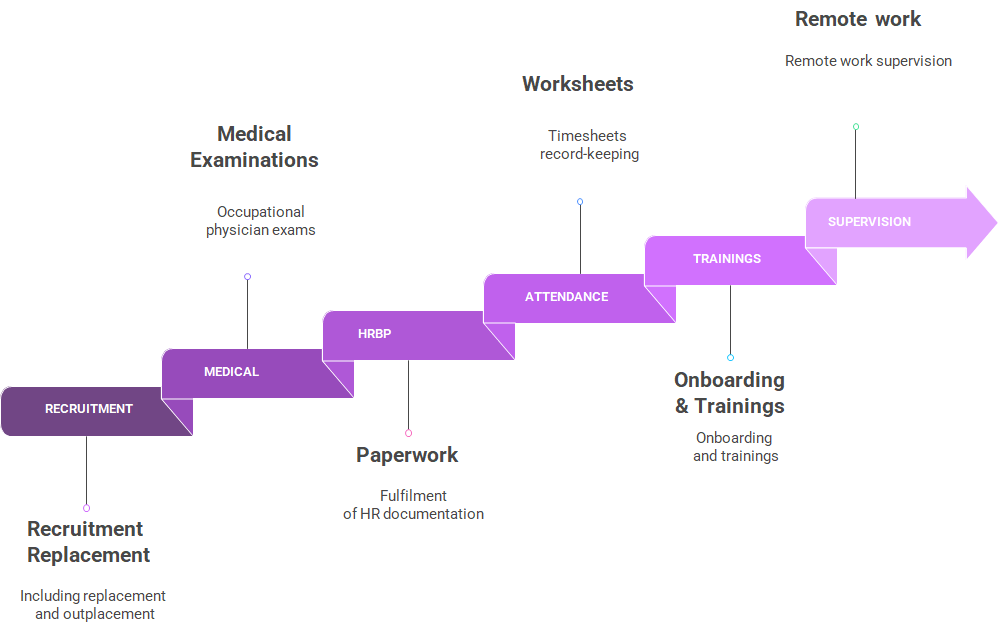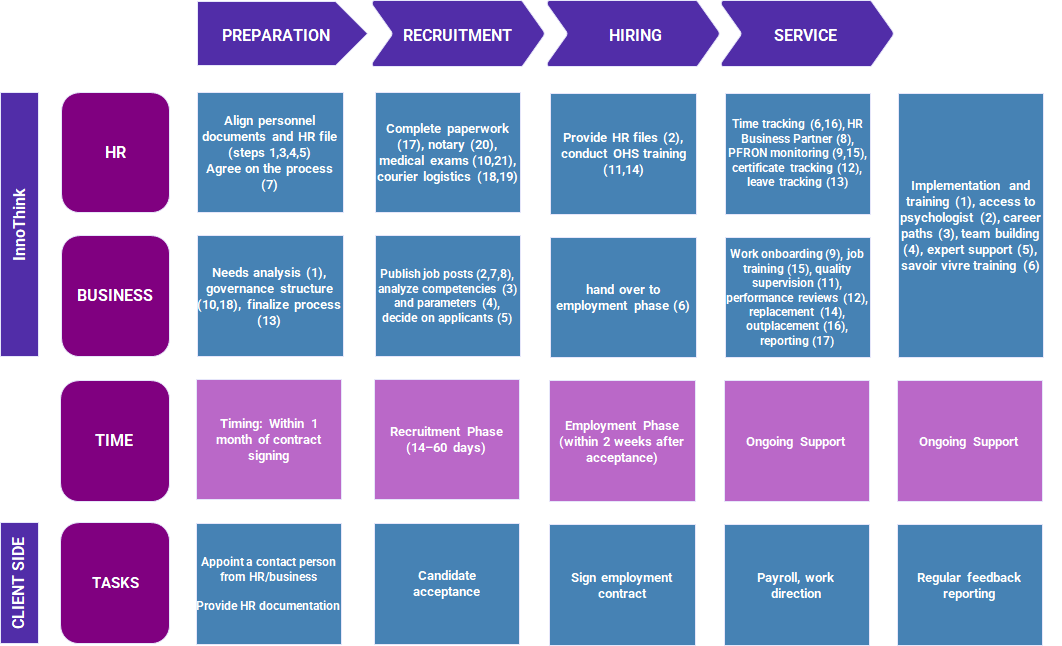
A typical project takes 4–6 weeks and includes the following stages to provide a comprehensive approach.
The analysis stage needs two decisions: who approves the project and who provides the work. See the two decisions needed to launch a project.
Recruitment and integration also depend on the order of work. An earlier case follows the building of a remote BPO team employing people with disabilities.
The InnoThink model is based on building remote teams of qualified specialists with disabilities tailored to the client’s business needs. It allows companies to eliminate the PFRON penalty entirely, gain valuable employees, enhance organizational culture, and fulfill ESG and CSR objectives.
It includes needs analysis, recruitment, equipment setup, and integration training. InnoThink coordinates the entire process — from PFRON audits to onboarding. First teams typically launch within a few weeks, depending on scope.
Implementation begins with employment data and the PFRON penalty. We then select tasks, build the business case and agree responsibilities. Once the decision is made, we launch recruitment, access to tools, onboarding and operations. Timing depends on the number of people, role profiles and the speed of client decisions. A small initial team and a team of several dozen people do not follow the same schedule.
The plan records InnoThink’s activities and the client’s decisions separately: approval of positions, scope of work, candidate selection, documents and system access. Each item has an owner and deadline. If the company does not approve access or respond to candidate profiles, recruitment alone cannot accelerate the start. We confirm the launch date after checking these dependencies, rather than relying on a universal promise.
We organise the project to minimise the workload on the client’s HR team. InnoThink can take over most agreed operational activities, including recruitment, implementation coordination, employee support and administration. The client retains employer decisions and control over its data and processes.
We agree the division before launch: what the client must approve, what it wants to retain and what it transfers to InnoThink. If the tasks left with HR begin to block operations, we adjust the service scope rather than preserve a fictional split of responsibilities. Minimal involvement does not mean no responsibility: someone on the client side must approve documents and make decisions.
Flexible hours, clear communication procedures, and tailored tools are key. InnoThink supports employers in organizing home workstations to ensure persons with disabilities can work comfortably and productively.
InnoThink’s remote model removes the need to adapt the client’s office for this team. It does not eliminate the cost of a computer, system access or organising a home workstation. We determine the equipment and any assistive technology required for the specific person and role before launch.
We check ergonomics, connectivity, tool accessibility and whether the tasks can be performed safely. If additional equipment is needed, we agree its owner and cost before approving the business case. We do not automatically assign specialist equipment to every person, but we also do not assume that one standard package will work for everyone.
The employee uses devices, accounts, VPN, permissions and safeguards that comply with the client’s policy. Disability itself does not require a redesign of IT systems. Additional solutions may follow from digital accessibility or a specific person’s needs, such as a screen reader. We agree them with IT and security before launch rather than create a separate, weaker security standard.
IT receives a description of the role, required applications, access scope and workstation-readiness deadline. Access to client data and health-related documents should be no wider than the task requires. We also define how access is withdrawn after a role change or termination. If a mandatory tool is inaccessible to a candidate, we resolve this before employment rather than after production work begins.
Education and transparent communication are essential. We recommend training teams in inclusive practices before onboarding. InnoThink provides such training. Also, preparing the work environment and discussing necessary accommodations ensures smooth integration.
Integration is designed from day one through onboarding, a buddy, a meeting rhythm, access to knowledge, shared tasks and informal contact. A remote employee should be part of the information flow, not merely a name added to a list. This does not require participation in every company activity. What matters is the opportunity to collaborate, speak up and build relationships in the team’s normal rhythm.
The implementation owner checks not only whether training was completed, but also whether the employee can access materials, knows whom to ask and receives feedback. The agreed contact rhythm should fit a seven-hour working day. An invitation to one event does not prevent isolation if everyday decisions still happen without the employee.
Yes. InnoThink provides operational and HR support: documentation, PFRON monitoring, training, coaching, and team development. A dedicated advisor oversees your remote team’s performance and strategic growth.
In the InnoThink model, employees work seven hours a day. We set goals, schedules and KPIs for the actual working time rather than transfer an eight-hour template from another team. Working time and absences are recorded through the agreed process. A shorter day does not remove accountability for results; it simply requires sensibly designed work.
Under the adopted model, a seven-hour day represents full-time employment, not automatically 7/8 of a position. The manager plans workload and availability on this basis, while payroll confirms the applicable working-time standards for each employee. We assess work quality by delivery of agreed tasks, not by the number of hours displayed as online in a messaging app.
Before launch, we agree a procedure for contact, escalation and documentation of incidents during remote work. The employee knows whom to notify, the manager knows when to involve HR or occupational health and safety, and the company retains its own accident-response rules. InnoThink supports communication and coordination. It does not replace emergency services or the employer’s responsibility.
When life or health is in immediate danger, assistance takes priority over paperwork. The employer handles the subsequent incident process with the people responsible for occupational health and safety. We do not decide in advance that every incident at home either is or is not a workplace accident; the course and circumstances must be established through the appropriate procedure.
A matrix organisation needs a named sponsor, process owner, operational manager, HR role and clearly defined InnoThink responsibilities. We then establish one set of KPIs and a simple escalation path. An employee may work with several people, but should not have to guess every day who sets priorities or who decides when instructions conflict.
A good structure allows one person to approve the order of work and accept the result even if costs or goals are reported across several organisational lines. Financial and employment matters have separate owners, but the employee does not receive competing instructions. Disputes between departments are escalated to the named sponsor rather than transferred to the team.
A project that can withstand a sponsor change needs a documented business case, an operational owner, a decision-making sponsor and regularly reported results. The next person can then take over without reconstructing the entire history. If the project exists only in one enthusiast’s calendar, a role change is enough for it to disappear with that person.
The handover covers financial assumptions, scope of work, agreements, metrics, open risks and upcoming decisions. It also identifies a deputy for the operational owner. A new sponsor should see what the team delivers, what it costs and what will stop if it is closed. The project should defend itself through results, not through a relationship with the previous manager.